

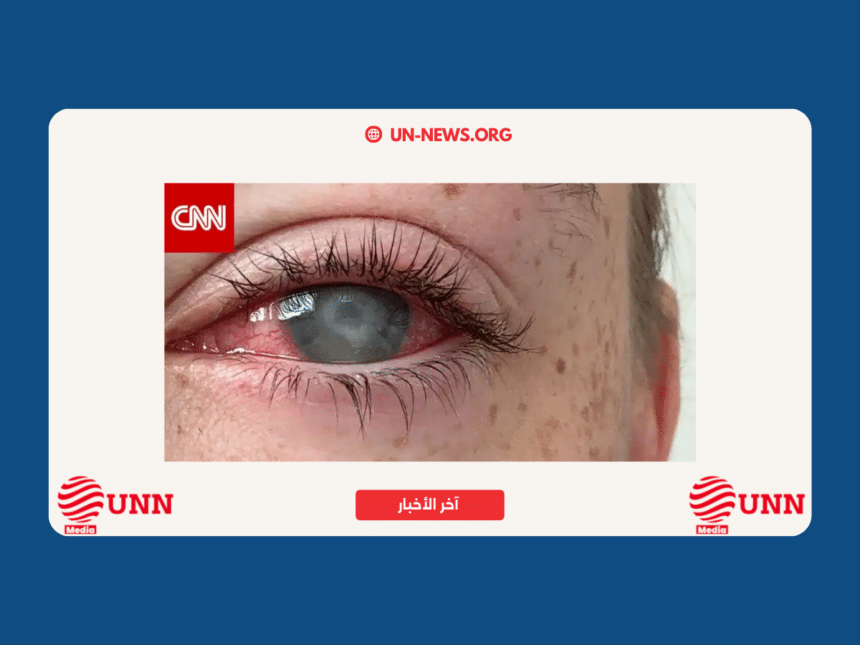
A parasitic disease threatens the eye health of contact lens users.. How can it be avoided?
Dubai, United Arab Emirates (CNN) — Teresa Sanchez, a 33-year-old living in Las Vegas, began feeling a dry, stinging sensation in her right eye about four years ago while in Mexico for a medical checkup.
Sanchez attributed this feeling to a potential tear in a contact lens or general dryness she felt after switching from daily to monthly lenses.
However, three months later, it became clear to her that the cause of her symptoms was a tiny foreign organism waging war on her cornea, which led to permanent damage to her vision and caused severe, burning pain that radiated throughout her head.
“I couldn’t open the curtains in my room because it caused such intense pain in my eye,” Sanchez said, describing her initial experience, adding that she realized the gravity of the situation and began searching for the cause herself.
Through online research, Sanchez discovered that her symptoms matched a rare condition known as “Acanthamoeba keratitis,” a diagnosis later confirmed by a specialist ophthalmologist.
The term “keratitis” refers to an inflammation affecting the protective outer layer of the eye, known as the cornea, which plays a fundamental role in vision.
Dr. Jacob Lorenzo-Morales, a professor of parasitology at the University of La Laguna in Spain, noted that the parasitic Acanthamoeba is a single-celled organism that does not require a host to survive. It is commonly found in water sources and soil and is one of several pathogens or microbes that can lead to keratitis.
Dr. Paul Barney, an optometrist and director of the Pacific Cataract and Laser Institute in Anchorage, Alaska, commented that once this opportunistic parasite reaches the surface of the eye, it adheres to the cornea.
Barney added that the parasite penetrates the cornea if there are cracks or scratches in the corneal epithelium, a thin layer that forms a cellular barrier highly sensitive to pain.
Although Acanthamoeba keratitis is considered rare, 2023 data from only 20 countries (including Brazil, Canada, the United Kingdom, India, and the United States) show a record of 23,000 cases annually worldwide.
Notably, between 85% and 95% of those infected with Acanthamoeba keratitis wear contact lenses, as these lenses are considered a suitable environment for the transmission of Acanthamoeba.
Contact lenses can cause scratches in the cornea, providing an entry point for the pathogen. Acanthamoeba can also adhere to the lens surface or become trapped between the lens and the eye, allowing it to penetrate deeper.
Barney explained that an infection with Acanthamoeba keratitis “can be extremely devastating if not diagnosed quickly and managed with intensive treatment,” noting that the parasite uses the cornea as a food source, leading to inflammation and tissue damage, which may result in permanent loss of vision.
Barney indicated that the vision of some patients can be partially restored with appropriate treatment, or fully restored through a corneal transplant.
The Acanthamoeba parasite is unique in its high ability to perceive threats and respond with effective defense mechanisms, which prolongs the treatment period that may extend for months or years, often filled with challenges and pain.
United News Network – UNN Arabic
An independent media platform providing reliable news and objective analysis, seeking to promote peace and cultural dialogue worldwide, to convey the truth and build bridges of understanding between peoples.
For more news, you can visit our homepage: