


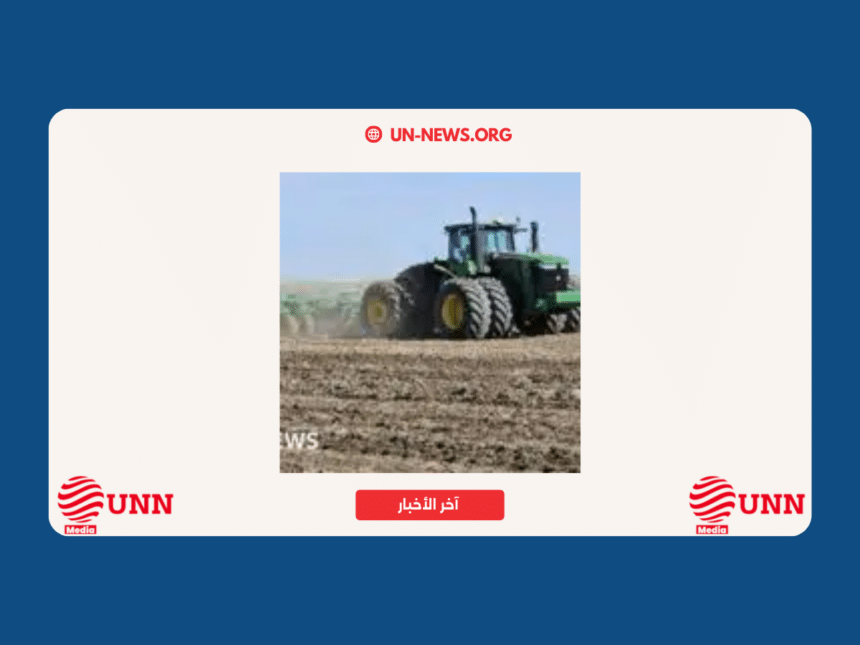
Government reports indicate that the United States currently has fewer agricultural fields, but is witnessing a greater accumulation of technological innovations, giving it more “technological density.”
Jake Leguee, a third-generation farmer in Saskatchewan, Canada, grows canola, durum, peas, and lentils. Since his grandfather bought the 17,000-acre land in 1956, the Leguee family has continued to cultivate a variety of crops. As a child, Leguee watched his father and grandfather spend hours driving tractors to plant seeds and operate sprayers. Sweat would cover their clothes after those long, hot days.
“It was much less efficient in the past,” Leguee says. “Today, technology has contributed significantly to improving the work we do.”
To keep his farm competitive, Leguee introduced several innovations, particularly regarding agricultural spraying. With operating software and remote cameras mounted on his John Deere tractor, he can eliminate weeds with much higher efficiency. This practice involves all farmers who must spray pesticides before planting seeds.
“It can look down and spray through a nozzle when the sensors detect weeds, while we move at 15 miles per hour,” Leguee explains.
He continues that he can save on pesticides because the sprayers only activate when weeds are detected, unlike the type used before that covered the entire crop.
Leguee emphasizes that the return on investment for adding these new technologies is almost always high. He says: “There are low-cost solutions that won’t be as expensive as spraying technology; there might be apps that help you improve your records better, for example.”
This is a lesson being accepted by farmers across North America. A 2024 McKinsey survey, which can be found here, showed that 57% of farmers in North America believe they will adopt new technologies to increase yield in the next two years. Another report, issued in 2022 by the US Department of Agriculture, explains that while the number of farms in the country has decreased, existing farms have become more “technologically dense.”
Norah Lake, owner and farmer at Sweetland Farm in Vermont, says that achieving a successful harvest requires “looking forward more, then back, then forward, then back in farming.”
Previously, Lake was using Microsoft Excel to crunch numbers, such as the yield from a recent harvest or a specific year, and comparing it to previous years.
“I want to know, for example, that we planted 100 feet of broccoli, so what did we actually produce?” she explains.
Recently, Lake, who grows vegetables like carrots, tomatoes, and squash, in addition to the meat the farm produces, began using software and an app store from a company called Tend.
Lake wants to transform and simplify these tedious tasks into technology that can be viewed on her mobile phone or computer. Now she can enter harvest numbers into Tend, and the software provides her with details and information on how to better manage the crop for the next harvest.
“We can use Tend to calculate the amount of seeds we need to order based on the measurement of a specific row of a crop we want to obtain,” she says.
There is no shortage of technology for farmers to choose from. Syngenta, the Swiss-based global ag-tech giant, suggests the Cropwise program for farmers, which uses artificial intelligence and satellite imagery to guide farmers on what to do next as quickly as possible, or notifies them of emergency errors.
Feroz Sheikh, Chief Information Officer at Syngenta Group, says: “It can tell the farmer to head to the southeast corner of his farm because something essential is missing in that area, such as a sudden pest outbreak. The system also has 20 years of weather pattern data fed into a machine learning model, so we know exactly what conditions lead to what outcome.”
With this data, a farmer can cover his crops before, for example, a sharp drop in temperature occurs that could kill a large part of his agricultural area.
In Germany, Jan-Pawel Lutz founded NoMaze to support farmers in gaining a deeper understanding of how different crops perform under climate conditions.
Its software will be launched this year. “We conducted ground tests in diverse environments and then sent samples through our computer model, so we can provide better insights to customers, such as the amount of water to use and how to get the highest possible yield,” he explains.
The end public may feel the impact of these technologies, says Heather Darby, a soil scientist and agricultural expert at the University of Vermont. Bringing more food to the market could lead to lower prices in the budget. Darby says: “When farmers provide help to avoid crop failure, it can lead to a more controlled agricultural environment and safe, reliable food systems.”
Back in Saskatchewan, Leguee says that younger farmers are using technology while older farmers might resist very large changes.
He says that farmers must be open to change. “After all, when you think about it, some of these farms are multi-million dollar businesses supporting multiple families. We must embrace the technology that fits us.”
Leguee says: “I hear someone say: ‘If you treat farming as a business, it’s a great way of life, but if you treat farming as a way of life, it’s a bad business.'”
United News Network – UNN Arabic
An independent media platform providing reliable news and objective analysis, seeking to promote peace and cultural dialogue around the world, to convey the truth and build bridges of understanding between peoples.
For more news, you can visit our homepage: