

Jeddah Municipality Reveals Details of Its Preparations to Face Rain Conditions
The Director of the Crisis and Disaster Center at the Jeddah Governorate Municipality, Faisal Aiban, confirmed that any rain alert issued by the National Center of Meteorology, regardless of its degree, is taken with high importance according to Jeddah Municipality’s estimates. This involves maximum readiness at 15 support centers distributed near critical sites and leading roads, while response varies depending on the rain condition witnessed by the governorate.
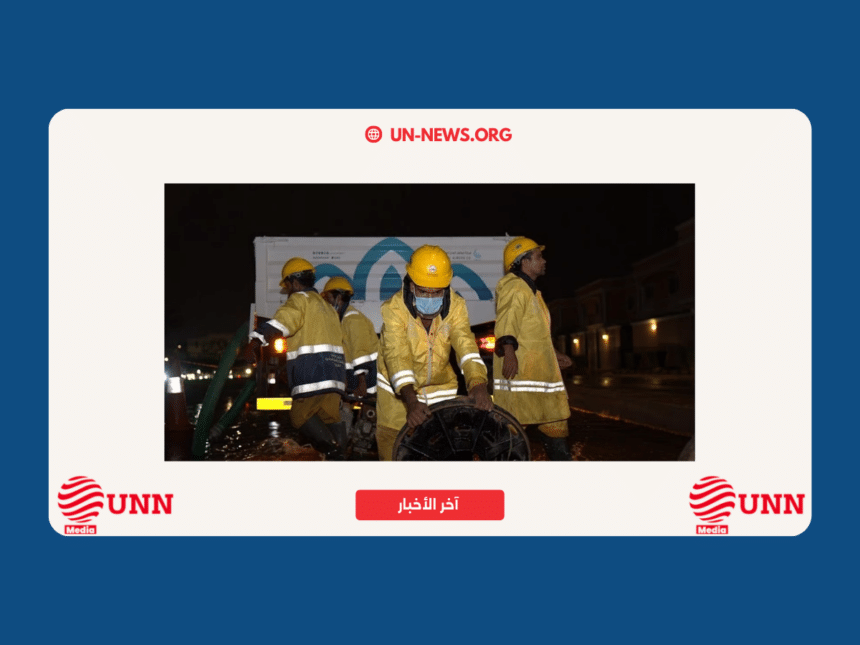
He pointed out that the field teams carrying out their duties in facing rain conditions follow 11 municipalities and 15 support centers, backed by 7,160 individuals and 1,621 pieces of equipment and machinery.
He explained that the first steps in dealing with rain conditions begin with preparations before the rainy season, in what is known as the “readiness phase.” This includes a set of proactive measures aimed at raising the level of preparedness and reducing potential risks by reviewing and updating emergency plans for rain conditions in line with operational developments, benefiting from lessons learned from hypothetical exercises and previous experiences, as well as similar experiences in other regions.
He indicated that during this phase, early coordination takes place with relevant authorities, and critical sites, water pooling points, valleys, and torrent paths monitored since last season are identified, along with including new critical points and placing them within the priority list, and then updating risk maps.
He said: “We work to ensure the readiness of field teams, equipment, machinery, support centers, rainwater drainage networks, and canals before the start of the rainy season, in addition to subjecting them to periodic maintenance and tests. Furthermore, we implement internal and external awareness campaigns to raise awareness of preventive measures and test communication channels and information exchange mechanisms between the operations center and partner agencies through operational hypothetical exercises.”
He added that as soon as alerts from the National Center of Meteorology are received via the automated early warning system, the Operations and Emergency Center at Jeddah Municipality works to receive the alert and analyze it in terms of the degree of danger, accompanying effects, and the geographical and temporal scope of the rain condition.
He explained that after completing the analysis of the alert, it is circulated to the concerned departments and authorities in the municipality according to the approved communication matrix, which includes email, wireless network, and direct phones, while ensuring the presence of personnel and machinery and their positioning in the support centers, and continuously following up on reports of new conditions and their needs.
Aiban noted that raising the appropriate level of readiness, whether through monitoring, preparation, or response, depends largely on the alert degree; however, readiness is at its maximum for any alert in anticipation of a sudden change in its degree.
In the event that the rain condition is classified within the Red Alert, he explained that the municipality’s full capacities are stationed in the support centers a maximum of 120 minutes before the start of the condition, with critical sites and priority areas, such as hospitals, tunnels, and main streets, being reinforced with equipment a maximum of 60 minutes before the condition begins.
He added that the Crisis and Disaster Center and the Support and Response Department at Jeddah Municipality represent the coordination hub when activating specialized committees for managing the situation, which include representatives from concerned authorities, with updated reports continuously submitted to the head of the rain committee, and coordination with the General Department of Institutional Communication to broadcast warning and awareness messages before the start of the rain condition.
He continued: “As soon as rainfall begins, the situation is monitored in the field and operationally around the clock via the Operations and Emergency Center. We monitor rainwater drainage networks and canals and critical sites, receive reports and address them according to priorities, in addition to supporting field teams and making decisions to escalate response when needed, and informing concerned authorities and decision-makers of developments.”
In light of the development of the system of machinery and equipment for dealing with the effects of rain, he noted that the work of assessing damages and operational notes, and pumping water from affected sites and treating them according to priority, has become faster than before. He stressed that Jeddah Municipality works to restore conditions to normal as soon as the rain condition ends, in coordination with the specialized departments and authorities.
He pointed to the preparation of reports including performance evaluation and extraction of lessons learned, upon which plans and procedures are updated again for application in subsequent rain conditions.
He emphasized that the plans for dealing with rain conditions in the General Department of Emergencies and Crises at Jeddah Municipality were not born of the moment, but came after a series of hypotheses, experiments, and lessons learned from every rain condition witnessed by the governorate, in addition to parallel experiences in several cities in the Kingdom, noting that these plans are subject to continuous updating throughout the year.
He stated that the Jeddah Governorate Municipality implemented seven field, office, and operational hypotheses, and others in partnership with relevant authorities, in an effort to uncover operational gaps and areas for improvement, raise the readiness of personnel, adopt the strategy for facing rain, enhance integrated work, transfer knowledge, and improve the speed of decision-making and the accuracy of information exchange, along with developing more flexible and realistic response scenarios.
United News Network – UNN Arabic
An independent media platform providing reliable news and objective analysis, seeking to promote peace and cultural dialogue around the world, to convey the truth and build bridges of understanding between peoples.
For more news, you can visit our homepage: