


Nepalese authorities have announced the cancellation of a plan to encourage climbers to bring back trash from the summit of Mount Everest, labeling it a “failure,” according to what Nepalese bodies told the BBC.
Climbers were required to pay a deposit of $4,000 (about £2,964), which was refundable only if they brought back at least 8 kilograms (18 pounds) of trash upon their descent.
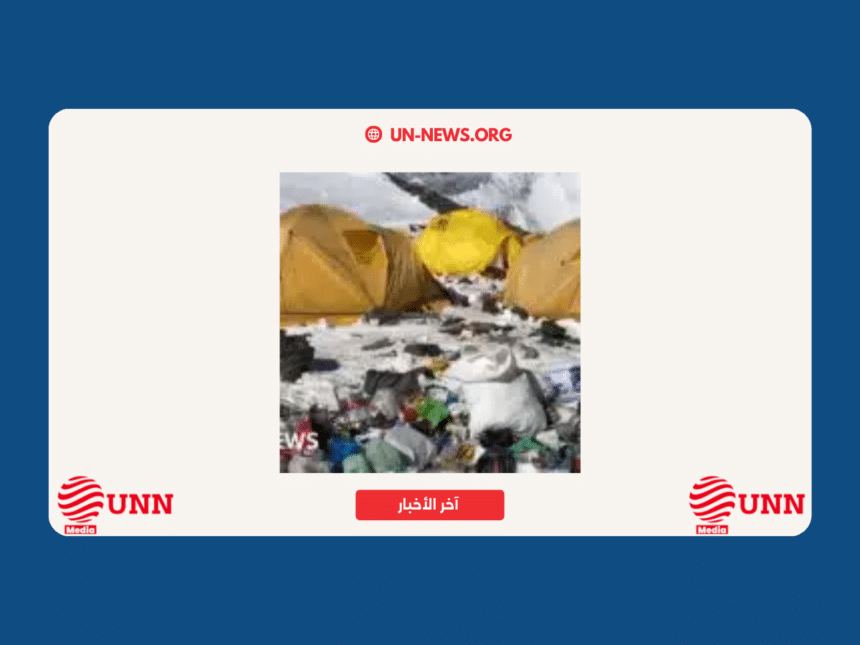
The plan was established with the hope of addressing the waste disposal problem in parts of the world’s highest peak, which scientists estimate could be covered by as much as 50 tons of trash.
However, after 11 years—and even as trash continues to accumulate—the plan has been scrapped because it “did not prove clearly effective.”
The problem of trash accumulation is most evident in the upper camps of Everest, according to authorities.
Himal Gotam, a director at the Ministry of Tourism, told the BBC that the problem has not only persisted but the plan itself has become an “administrative burden.”
Ministry of Tourism and mountain management officials told the BBC that most of the deposit money was returned to companies and climbers over the years—suggesting that most climbers were bringing their trash back.
But the plan is considered a failure because the trash brought back by climbers is usually from the lower camps rather than the high camps, which suffer from the worst waste problem.
Tshering Sherpa, executive director of the Sagarmatha Pollution Control Committee, which manages a checkpoint on Everest, said that “people tend to bring back only oxygen canisters from the high camps.”
“Other things like tents, cups, and food and drink cans are mostly left there, which is why we see large quantities of trash accumulating.”
Sherpa added that climbers discard an average of up to 12 kilograms (26 pounds) of trash on the mountain, where they spend up to six weeks for acclimatization and climbing.
Authorities in the Everest region indicated that weak oversight is the primary challenge, along with the “flawed rule” that forces climbers to bring back less trash than they leave behind.
Sherpa said: “Barring the checkpoint above the Khumbu Icefall, there is no oversight on what climbers do.”
Nepalese authorities hope that a new plan will be more effective.
Cleanup campaigns typically focused on the lower camps of Mount Everest due to the difficulties and benefits associated with cleaning the high camps.
Under the amended rule, officials said a non-refundable cleaning fee for climbers will be used to establish a checkpoint at Camp Two, in addition to deploying mountain guards who will proceed to the high parts of the mountain to ensure climbers take their trash with them.
Ministry of Tourism officials said the fee will likely be $4,000 per climber—the same amount as the previous deposit—and it will be implemented once approved by Parliament.
Mingma Sherpa, chairman of the Pasang Lhamu rural municipality, said the change was something the Sherpa community had sought for years.
“We have been questioning the effectiveness of the deposit plan all along, because we don’t know anyone who was penalized for not bringing back trash, and there was no dedicated fund. Now, this non-refundable fee will lead to the creation of a fund through which we can conduct all cleaning and oversight work.”
Even parts lower than Everest’s base camp show discarded trash from visitors and climbers.
The increasing number of climbers on Mount Everest over the past years poses a growing concern regarding the sustainability of mountain climbing.
The non-refundable fee is part of a newly introduced five-year mountain cleaning action plan, which Jayanarayan Acharya, spokesperson for the Ministry of Tourism, said is designed to “immediately deal with the urgent problem of trash accumulation on our mountains.”
Although there is no study measuring the amount of waste on Everest, it is estimated that there are tons of it, including human waste that does not decompose in the upper part of the mountain due to freezing temperatures.
Authorities in the Everest region emphasized that the area is particularly vulnerable, and the increasing number of climbers each year—averaging around 400 people along with a larger number of field staff—poses a growing concern for the sustainability of mountain climbing.
United News Network – UNN Arabic
An independent media platform providing reliable news and objective analysis, seeking to promote peace and cultural dialogue worldwide, to convey the truth and build bridges of understanding between peoples.
For more news, you can visit our main page: