


Warning: This report contains material that may be distressing to some readers.
New agonizing videos from a forensic medical center in Tehran show rows of bodies, blood-stained floors, and groups of people searching for their loved ones, following the government’s violent crackdown on protests in Iran.
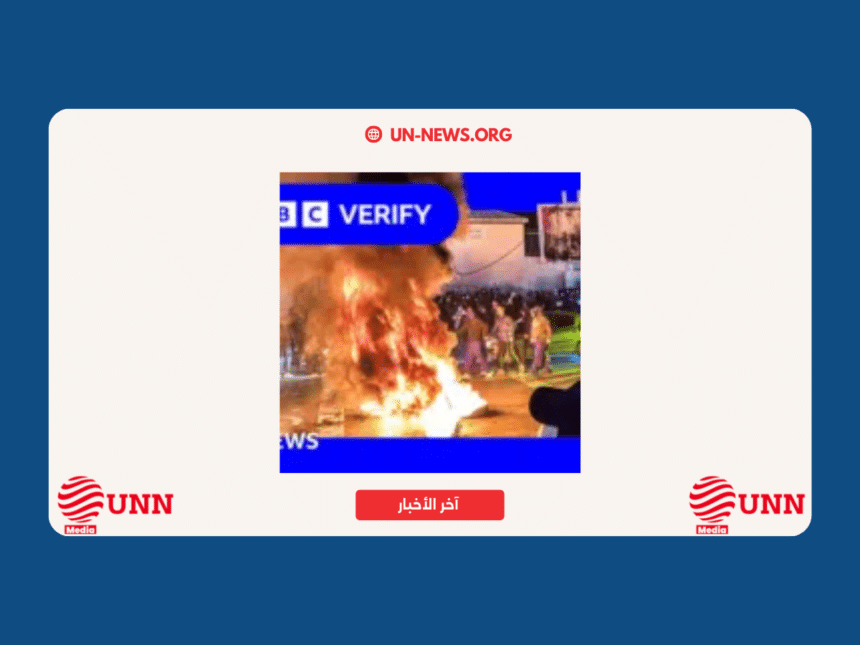
Videos analyzed by BBC Verify and BBC Persian include some of the worst examples yet of the government’s brutal response since the unrest broke out on December 28.
Forensic analysis of the footage revealed about 200 bodies distributed within forensic facilities, many with visible wounds, and one of the victims identified as being 16 years old.
Anti-government marches have spread to more than 68 cities and regions, as confirmed by documented videos, though the actual number may be much higher. A near-total internet blackout imposed by the government since last week has left 90 million people in Iran with very limited connection to the outside world.
The death toll in the marches remains unknown. The U.S.-based Human Rights Activists News Agency (HRANA) stated that estimates reach more than 2,500 people. An Iranian official previously told Reuters that 2,000 people had died but blamed “terrorists” for the responsibility.
A video posted by “Vahid,” an Iranian activist blogger living in the United States, on Tuesday showed it was filmed on January 10 inside the Kahrizak Medical Forensic Center in southern Tehran.
“Vahid” stated that the video was filmed by a person who traveled about 1,000 km to find an internet connection. The man told BBC Persian that he used cellular networks from neighboring countries to upload the video. “Vahid” has published dozens of videos recording events inside the country to make the outside world aware of them.
Two of the videos show rows of bodies sealed in body bags on the floor as the man walks along a path passing north of the large forensic laboratory building. He then moved into a hall, inside a large warehouse, moving in and out of adjacent rooms filled with other body bags. At one point, he can be heard describing the scene as “judgment day.”
It is likely the man filming says: “Today is Saturday, a day after the call.” This refers to the call issued by Reza Pahlavi, son of the Pahlavi dynasty king, for national uprisings that took place last Thursday and Friday night.
Two other clips show a collection of images taken from the forensic lab showing bodies sealed in bags, including one that appears to be charred.
BBC Verify and BBC Persian counted at least 186 bodies in the five-minute video and at least 178 bodies in the 16-minute video. It is possible the videos show some of the same bodies—we cannot be certain—but the true number may be much higher.
The videos include nine separate segments edited together. The light angles in the video suggest these sections were likely filmed at different times during the day. We coordinated identifiable features from the facility, including separate buildings, the red roof of the warehouse, and the fence, with satellite images on Google.
The man is filmed moving inside the center, where more bodies are stored on backboards as well as the floor. The video shows some bodies completely sealed in bags, while others are partially or fully unsealed, revealing the victims’ faces and their condition. Some are not fully covered. We can see blood-soaked tissues and sheets scattered throughout the lab and bloodstains on the floor.
Many bodies show head wounds. Other separate bodies appear drenched in blood, and another person shows a deep abdominal wound.
Some body bags carry attached papers or details described on the bags themselves in white ink, such as the name, national identification number, date of birth and death, and in some cases, the father’s name. At least two men are identified as “unknown” on papers attached to their bags, and victims include at least one woman and a teenager.
The date of death on three men’s body bags is identified as January 9. Another body bag shows a birth date using the Iranian calendar, stating 1/1/1388, which represents 21/3/2009, indicating it belongs to a 16-year-old boy.
During a moment in the 16-minute video, the man points his phone toward a building on his right, and a voice is heard saying: “There are many [bodies] inside. It’s impossible to enter… this is the women’s section.” Tehran’s morgues separate the bodies of men and women for religious reasons.
At a different time, we can see a body bag in the back of a pickup truck, and a nearby man tells a female employee that it is his sister.
Several ambulances, pickup trucks, and buses are shown around the site. Staff can be seen conducting investigations on the rows of bodies, taking swabs from victims, and speaking with potential relatives.
It is unclear why the bodies of those killed in anti-government marches were moved to the center, but eyewitness testimonies provided to BBC Persian suggest that hospitals may have become overwhelmed by the number of casualties from the uprising.
HRANA, which has been tracking the death toll since the start of the uprisings, estimated that 2,403 protesters, 147 government-affiliated personnel, 9 civilians, and 12 children have died so far.
Groups of people, several of whom appear to be families and friends, wander in and out of the lab while trying to identify bodies. Crying and wailing are heard repeatedly in the videos as people grieve the death of their loved ones.
“Some of our best youth have died,” the man filming can be heard saying.
A report by the Iranian state television channel mentioned that a “large number” of bodies were moved to the lab. It claimed most victims were members of the Iranian security forces or simply bystanders who had nothing to do with the uprisings.
Most international news agencies, including the BBC, are restricted from working inside the country, so we must rely on confirming videos on social media.
United News Network – UNN Arabic
An independent media platform providing reliable news and objective analysis, seeking to promote peace and cultural dialogue worldwide, to convey the truth and build bridges of understanding between peoples.
For more news, you can visit our homepage: