


An American international law professor stated that any trial of Venezuelan President Nicolás Maduro, currently detained in the United States, or the justification for his arrest, may rely on a controversial internal legal opinion dating back to 1989.
Marjorie Cohn, a professor of international law and former president of the National Lawyers Guild in the United States, told Al Jazeera Mubasher that the trial comes at a time when Washington’s practices reflect a recurring pattern of obstructing the application of international law.
Cohn emphasized that “the U.S. Constitution clearly states that ratified international treaties are the supreme law of the land, and judges must abide by them,” noting that the United States is a party to the UN Charter, which does not permit the use of military force against another state except in self-defense or with authorization from the Security Council.
She added, “Neither of these conditions was met in the case of Venezuela, and it did not pose any imminent threat to the United States.”
The American expert considered that characterizing what happened as a law enforcement operation lacks any legal basis, as “no country has the authority to enforce the law within the territory of another country unless it obtains its explicit consent, which Venezuela did not grant.” She added that this constitutes a clear violation of sovereignty, both under the UN Charter and the rules of customary international law.
Regarding Maduro’s immunity, Cohn said, “Nicolás Maduro enjoys head-of-state immunity, which is not waived simply because a country does not recognize him politically, especially since the United States itself previously recognized him as the president of Venezuela.”
In this context, she pointed to a striking legal irony, noting that “the U.S. Supreme Court recently granted broad immunity to the U.S. President for official acts, which the defense may also rely on in this case.”
Panama
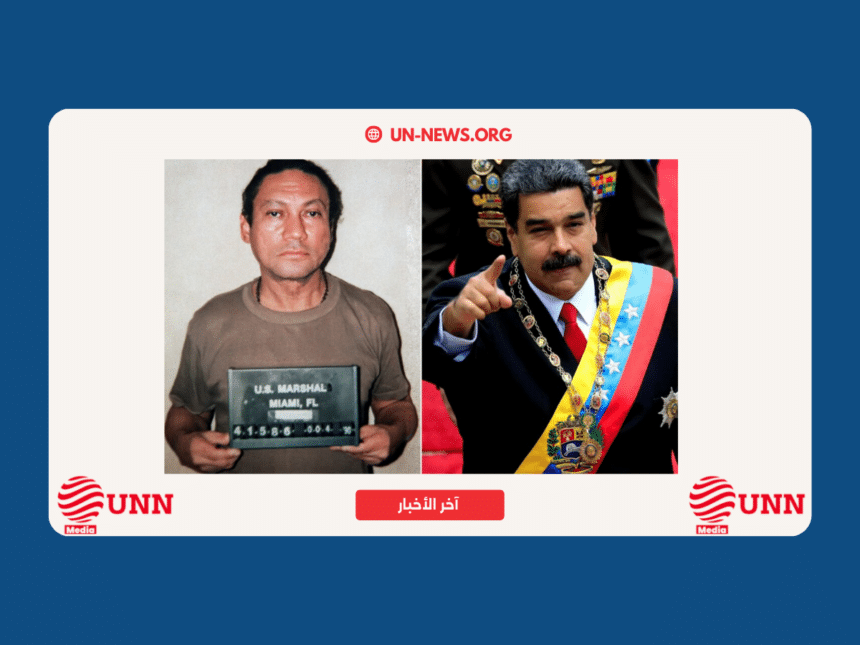
Cohn pointed out that the deeper issue lies in the possibility of the U.S. prosecution relying on a legal opinion issued by the Department of Justice in 1989, months before the U.S. invasion of Panama and the arrest of then-Panamanian President Manuel Noriega.
She explained that “this opinion grants the U.S. President apparent constitutional authority to issue orders for the arrest of persons outside U.S. territory, even if it violates customary international law and state sovereignty.”
She added that this interpretation goes as far as considering U.S. law superior to the UN Charter, and even claims that the Charter does not prohibit forced abductions abroad.
Cohn considered this legal opinion to be “the subject of wide debate in legal circles, has never been endorsed by the U.S. Supreme Court, and is not legally binding,” while simultaneously warning that the current composition of the Supreme Court, which tends to expand executive powers, raises serious questions about how these issues will be handled if presented to it in the future.
Regarding the potential consequences, the American expert said that “Maduro could face, if convicted, a maximum penalty of life imprisonment under U.S. law.”
She considered these potential penalties to reveal the danger of using the judicial system as a tool in international political conflicts, rather than just a means of achieving justice.
Gaza Strip
In a broader context, Cohn linked Maduro’s case to Washington’s record of obstructing international law, stating that “what is happening in the Gaza Strip is a clear example that the United States does not always adhere to international law, even though it is bound by it under treaties and customary international law.”
She added that Washington “uses its political influence, including the veto power in the Security Council, to obstruct the implementation of International Court of Justice rulings, even when these rulings point to grave violations of international law.”
Cohn stressed that “normalizing the prosecution of other heads of state based on controversial domestic laws, while continuing to obstruct international accountability mechanisms, undermines the foundations of the global legal system.”
She concluded that this approach perpetuates a selective application of international law, where rules are imposed on weaker nations while being suspended or reinterpreted when it comes to major powers, threatening the credibility of the entire international legal system.
United News Network – UNN Arabic
An independent media platform providing reliable news and objective analysis, seeking to promote peace and cultural dialogue worldwide, to convey the truth and build bridges of understanding between peoples.
For more news, you can visit our homepage: