


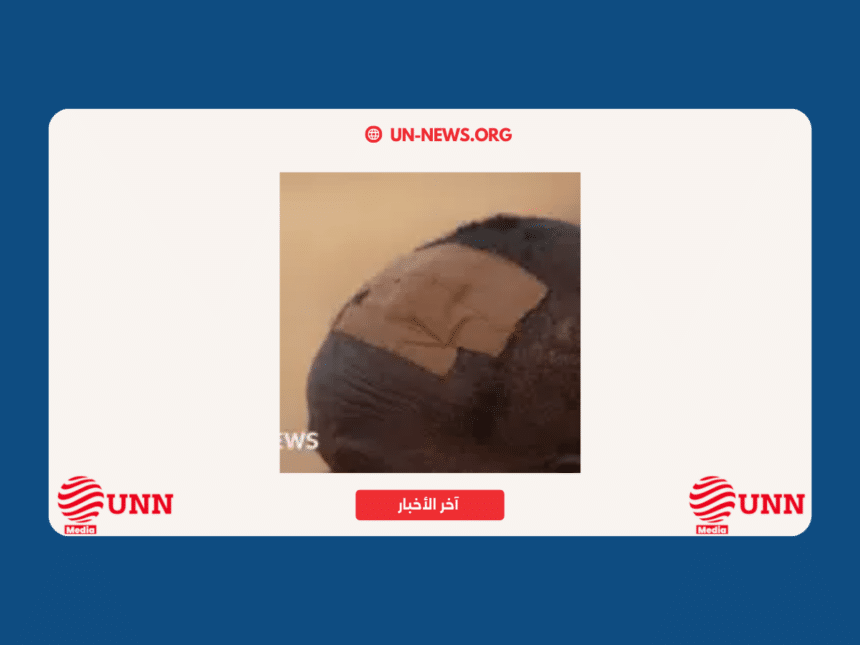
In Nigeria, Sarah Peter (a pseudonym) was injured on the head while attempting to escape attackers who rushed them while she was at a church in a village in the north of the country; she managed to escape despite her injury. The 60-year-old Sarah was at a church in a northern Nigerian town on Sunday when attackers arrived to kidnap worshippers and force them to walk away.
“Blood was covering everywhere,” she said, looking at the site of the wound. “I have pain,” she added, with the impact of what happened three days ago clearly still lingering. “They kept dragging me even though I told them I couldn’t walk. Then I disappeared somewhere until I could no longer see them. I was weak and had to crawl on my hands and knees until I returned to the village.”
Hundreds of others were dragged from a church belonging to the Cherubim and Seraphim Movement Church and two others in the village of Kurmin Wali, a village 135 km (84 miles) north of the capital, Abuja, as confirmed by the Kaduna Church Committee.
Although 11 people managed to escape, including Sarah, more than 160 people still have an unknown fate, according to the local branch of the National Christian Coalition of Nigeria.
Residents who remained in the village pointed to grief and fear of increasing attacks. Authorities have not released any figures regarding the missing persons.
Kurmin Wali is located near the Rijana Forest in Kaduna State, which is a hideout for armed groups known locally as “bandits,” who carry out ambushes and kidnappings in the region. No group has claimed responsibility for Sunday’s incident, but the attack is considered part of a broader security crisis in Nigeria, where kidnapping for ransom has become increasingly common.
In Nigeria, paying ransom is illegal, but it is often suspected that money is passed to free the kidnapped. In this case, no ransom demands have been recorded so far.
The issue gained increasing international attention after US President Donald Trump claimed last year that Christians were being targeted and killed in a systematic manner. Last month, the US military conducted an airstrike against camps of suspected radical Islamist militias in northwestern Nigeria.
Nigerian officials emphasized that Christians are not a target of oppression because of their religion, noting that Muslims, Christians, and non-believers are all affected by the stability crisis.
Gloom and anger overwhelm the village of Kurmin Wali. The village leader said that people have lived in fear for a while. Local residents complained about the deteriorating level of security and accused authorities of suppressing information after the incident occurred.
This was followed by 48 hours of confusion where authorities initially denied that anything had happened, despite first-hand testimonies; the events were eventually confirmed on Tuesday evening. “They told us not to promote the information; they want to intimidate us, but we must tell our story. They also prevented some journalists from entering the town,” said a young man in his twenties, who refused to reveal his identity.
It seemed that authorities were hesitant to allow details of the news to emerge, but Kaduna State Governor Uba Sani told the BBC that authorities wanted to confirm all details before issuing a statement. However, this does not explain why the local police chief and the top government official initially denied the existence of any attack, considering the reports as mere “crying intended to create chaos.”
The BBC faced difficulty reaching Kurmin Wali, as a politician and security personnel tried to block entry to the village, but it managed to gain access. Upon entering, a scene of chaos was found in the Cherubim and Seraphim Movement Church. Colored plastic chairs were on the floor, religious books scattered on the ground, and musical instruments broken, as if the moment after the attack were frozen in time.
Meters away, Christopher Yohana stared sorrowfully at his two-year-old child. He said he managed to escape the attackers with his child. “We were in church when we heard the screams. When we went out and tried to escape, we saw that gunmen had already surrounded our village,” he said.
He was lucky to avoid capture, but he is exhausted because his two wives and other children were unable to escape. “If my family is away from me, my life is worthless and without any happiness,” he said.
Governor Sani visited Kurmin Wali village three days after the attack, signing a commitment to establish a military base, a hospital, and a railway in the area. He also announced relief measures for those affected, including medical support.
“We cannot relocate them because they need to farm… but to ensure their future protection, we need a military base in the area between the village and the Rijana Forest,” the Governor told the BBC.
He also stated that efforts are underway to cooperate with security agencies to rescue the people still in captivity. “When I met them [the villagers], I assured them that we are with them, and we will strive to ensure that none of them are disappointed.”
While the residents of Kurmin Wali wait anxiously for their return, they hope the Governor keeps his promise. Local residents also add that state and local officials tried to prevent the submission of names of the kidnapped residents or hide some details. There is concern that these developments may stem from the low level of security stability and the understanding gap between the native residents and the authorities—a point that emphasizes the importance of transparency in such tragic situations.
United News Network – UNN Arabic
An independent media platform providing reliable news and objective analysis, seeking to promote peace and cultural dialogue around the world, to convey the truth and build bridges of understanding between peoples.
For more news, you can visit our homepage: