
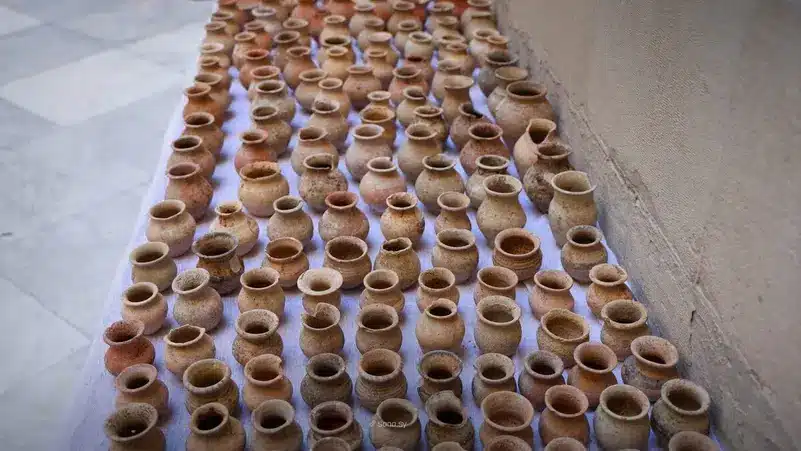
The Syrian Ministry of Culture honored, several days ago at the National Museum in Damascus, citizen “Diyaa Al-Din Khannous” in recognition of his integrity in preserving 513 archaeological artifacts found in the southern countryside of Idlib in 2014. He kept them throughout the years of war and displacement before handing them over to the General Directorate of Antiquities and Museums.
“Khannous,” who is from the town of Maarat Hirmah, explained in a video posted by the ministry on Wednesday evening through its “X” account that the artifacts were found while digging a shelter to protect his family and neighbors from shelling. He kept them throughout the years of displacement, moving between more than 15 homes, despite receiving financial offers to sell them. He considered handing them over to be “a historic day and a great joy,” according to the official Syrian Arab News Agency, SANA.
Khannous said: “Our area was subjected to heavy shelling with various types of weapons and ammunition, so I began digging a cave to protect my children from the projectiles. During the digging, we were surprised to find a cave containing many archaeological artifacts.” He added that after the war ended, he contacted the General Directorate of Antiquities and Museums, which came to the site and received the artifacts.
During the ceremony, a collection was displayed that, according to initial estimates, dates back to the Early Bronze Age and the beginning of the Middle Bronze Age, between 3200 and 2000 BC. It includes pottery vessels and cuneiform tablets, giving it scientific significance for studying the history of the region.
Minister of Culture “Mohammed Yassin Saleh” affirmed that honoring “Khannous” embodies the authenticity of the Syrian citizen and his connection to his homeland, noting that handing over hundreds of archaeological artifacts to the state reflects a commitment to protecting and preserving heritage and making it available for scientific study.
“Saleh” explained that some of the cuneiform tablets may indicate, according to preliminary findings, a kingdom that had not previously been documented, which could open the door to further research and excavation, as well as the study of ancient languages, patterns of life, and forms of cultural production.
For his part, Deputy Director-General of Antiquities and Museums and Director of Excavations “Ayman Al-Nabu” said that he had inspected the site in 2014 and worked to secure and protect the artifacts, noting that “Khannous” took responsibility for preserving more than 15 boxes of archaeological finds despite the security risks that accompanied their transportation.
The honoring of Khannous comes as part of the efforts of the Ministry of Culture and the General Directorate of Antiquities and Museums to protect archaeological discoveries and encourage citizens to report them and hand them over to the competent authorities for preservation and study.
United News Network – UNN Arabic
An independent media platform that provides reliable news and objective analysis, and seeks to promote peace and cultural dialogue around the world, convey the truth, and build bridges of understanding among peoples.
For more news, visit our homepage:
Author: Counselor Faisal Al-Mutairi.
Publication Date: September 10, 2026.
Updated: September 2026.