
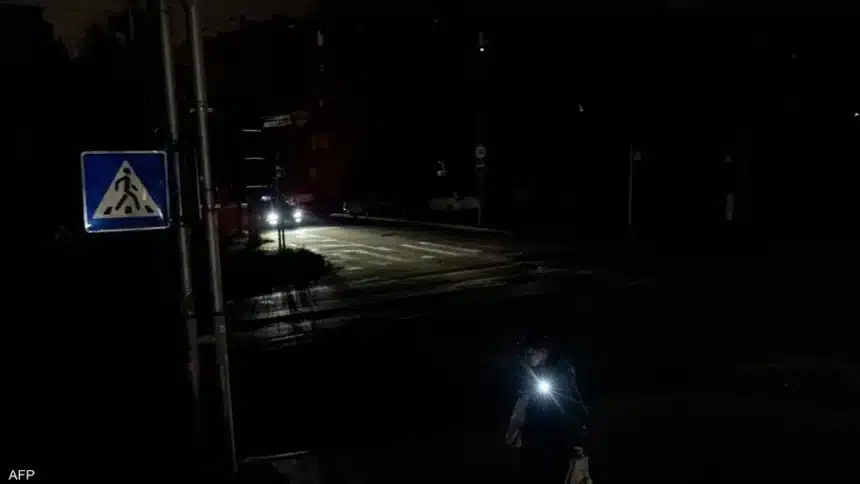
Kyiv, the Ukrainian capital, has been experiencing power outages for the second consecutive day, amid drone activity overhead and warnings of potential ballistic missile attacks. According to Mohammed Al-Arouqi, editor-in-chief of the website Ukraine Today, this situation contrasts with statements about contacts and meetings aimed at ending the war.
In an interview, Al-Arouqi said that official statements were moving in one direction while developments on the ground were moving in another. He ruled out any progress toward peace during the winter and accused Russia of exploiting the cold by targeting energy facilities to pressure Ukraine and force it into submission.
He called for a direct meeting between Russian President Vladimir Putin and Ukrainian President Volodymyr Zelenskyy, rather than relying solely on technical delegations and phone calls that cannot resolve disagreements over territory and security guarantees.
Al-Arouqi explained that temperatures could fall to minus 5 degrees Celsius, according to weather forecasts, while drones continued flying over the capital and air defenses attempted to intercept them.
He also pointed to Ukrainian military warnings of possible ballistic missile attacks at night, alongside calls for residents to seek shelter in metro stations and designated shelters.
He acknowledged Ukraine’s limited ability to protect its airspace and energy facilities, attributing this to a shortage of interceptor missiles for the Patriot air defense system. He stressed that civilian safety was the greatest concern amid the escalation in attacks.
He cited the killing of 19 people at a railway station in the city of Dnipro two days earlier, according to the casualty figure he provided, noting that the pace of escalation had increased in recent days.
By contrast, Al-Arouqi said he was not equally concerned about the situation facing the Ukrainian army on the front lines, arguing that its battlefield performance differed from conditions in cities coming under bombardment.
He added that the area of territory Ukraine had regained control of during October exceeded the area captured by Russia in the same month, citing a figure of approximately 94 square kilometers.
He also relayed Ukrainian estimates indicating that Russian losses amounted to around 54,000 troops killed and wounded. However, he emphasized that these figures came from the Ukrainian side and had not been confirmed by independent sources.
Al-Arouqi accused Moscow of maneuvering through its proposed channels of communication with Kyiv, including inviting Zelenskyy to visit the Russian capital or urging him to call Putin. He argued that such proposals did not address the core issues of the conflict.
He recalled that Zelenskyy had been calling for a meeting with Putin since 2019, noting that Russia’s responses had treated bilateral relations separately from the issues of Crimea and Donbas.
He argued that repeated statements about possible meetings in Miami and Abu Dhabi, as well as anticipated contacts, did little to boost Ukrainian morale. In his assessment, Russia’s objective remained “Ukraine’s surrender, nothing more and nothing less.”
Al-Arouqi criticized the practice of relying solely on technical delegations and called for a summit bringing together Putin, Zelenskyy, and U.S. President Donald Trump to resolve the outstanding issues.
He said the future of the territories, including the remaining parts of Donbas, required a decision at the presidential level. He expressed hope that Washington’s invitation to the G20 summit could provide an opportunity to hold such a meeting.
He added that a U.S.-mediated phone call could pave the way for setting a date for the summit, provided Moscow was willing to freeze the conflict and refrain from communicating with Kyiv on terms that treat it as “the defeated party.”
Regarding possible concessions, Al-Arouqi noted that Zelenskyy remained opposed to relinquishing territory. However, he said Kyiv had already made what he described as “painful” concessions by agreeing to freeze the conflict along the line of contact, leaving territories captured by Russia under its de facto control.
According to his account, around 11 to 12 percent of Donbas remains subject to negotiations, with the possibility of discussing its transformation into a gray zone or a demilitarized area. He stressed that Ukraine must receive security guarantees to prevent another war from breaking out in the coming years, arguing that Moscow’s insistence on imposing preconditions was obstructing a settlement.
He affirmed that Ukrainians wanted the war to end “today rather than tomorrow,” but remained determined to preserve their dignity and reject any negotiations that would amount to a declaration of surrender.
United News Network – UNN Arabic
An independent media platform providing reliable news and objective analysis, seeking to promote peace and cultural dialogue around the world, convey the truth, and build bridges of understanding among peoples.
For more news, visit our homepage:
Author: Counselor Faisal Al-Mutairi.
Publication Date: November 2, 2026.
Updated: October 2026.