
The presidential elections in Colombia have brought a new political shift within the Latin American landscape, after a runoff round resulted in a narrow victory for the right-wing candidate “Abelardo de la Espria.” While his supporters celebrated the outcome, protests erupted in several cities rejecting the results, reflecting the deep political polarization in the country.
A victory that strengthens the rise of the right in Colombia
The lawyer and businessman “Abelardo de la Espria,” who is backed by the United States and has never previously held public office, won the controversial runoff held on Sunday, narrowly defeating his left-wing rival “Iván Cepeda.”
With most votes counted, “de la Espria,” about 47 years old and relatively new to politics, secured the presidency against the leftist senator. Preliminary results showed him with 49.7% of the vote compared to 48.7% for his opponent, a philosopher and human rights advocate.
His election places Colombia among a growing number of Latin American countries shifting toward right-wing politics, following Argentina, Chile, and Ecuador, with leaders aligned with Washington quickly congratulating the president-elect.
An agenda focused on security and reducing the state
During his campaign, “de la Espria” pledged a hardline security approach and stronger action against organized crime. He is known for his admiration of Salvadoran President “Nayib Bukele” and Argentine President “Javier Milei,” and has vowed to build large prisons with strict conditions for inmates, as well as to bomb drug trafficking camps with support from the United States and Israel.
He also promised to reduce the size of the government workforce by 40%, as part of a broader plan to shrink the state apparatus. He is set to assume office on August 7, at a time when Colombia continues to face growing security challenges linked to more than six decades of internal armed conflict.
Meanwhile, his opponent “Iván Cepeda” refused to concede before the final vote count is completed, announcing plans to challenge results from around 33,000 polling stations.
Cepeda, about 63, enjoys strong support among the working class and is considered one of the key allies of outgoing President “Gustavo Petro.” His campaign highlighted social and economic gains achieved during Colombia’s first left-wing government, including reduced poverty and improved wages, despite persistent inequality.
Celebrations for the president-elect
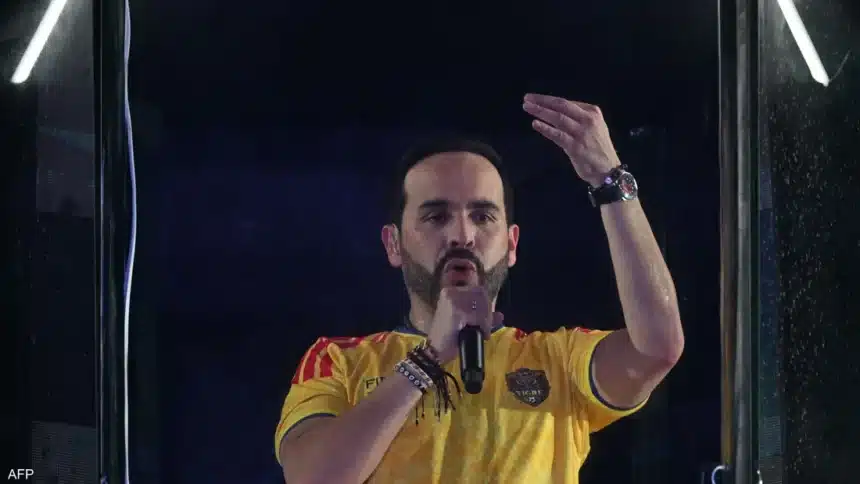
Behind bulletproof glass, “de la Espria” celebrated what he called “the beginning of a new era” in front of thousands of supporters gathered in Barranquilla in the north of the country.
Nicknamed “the Tiger” by his supporters, the president-elect pledged to continue pursuing armed drug trafficking groups, vowing to confront “bandits without mercy” within the framework of the constitution and law, and to govern for all Colombians without exception.
He also promised to restore security and stability after an election campaign marked by violence, including armed attacks and the assassination of a presidential candidate.
His victory received clear support from the United States, with President “Donald Trump” posting a photo of the Colombian millionaire on Truth Social with the message: “He won, and by a large margin.” US Secretary of State “Marco Rubio” also congratulated the president-elect, praising prospects for future cooperation on security and illegal immigration.
Protests and clashes in several cities
At the same time, thousands of supporters of “de la Espria” took to the streets in several Colombian cities to celebrate, wearing the yellow jersey of the national football team, which he adopted as a symbol of his campaign.
However, celebrations were accompanied by protests elsewhere. In Cali, the country’s third-largest city, demonstrators opposing the election results burned US flags and clashed with riot police, according to AFP reporters.
Similar protests took place in the capital Bogotá, where groups of young people expressed rejection of the president-elect. Brandon, a 19-year-old student, said the new government does not represent him and vowed that protests would continue. Natalia, a 26-year-old student, said the country needs leadership that serves all citizens, arguing that past right-wing governments focused on enriching the wealthy instead of addressing deep-rooted poverty.
United News Network – UNN Arabic
An independent media platform providing reliable news and objective analysis, aiming to promote peace and cultural dialogue worldwide, conveying truth and building bridges of understanding between peoples.
For more news, visit our homepage:
Author: Advisor Faisal Al-Mutairi
Publication date: June 22, 2026
Update date: June 2026