
Rising tensions continue between the United States and some of its European allies amid disagreements over the war with Iran and burden-sharing within the North Atlantic Treaty Organization (NATO). Against this backdrop, U.S. President Donald Trump delivered sharp criticism of several European countries, accusing them of failing to stand by Washington when it needed support, ahead of an anticipated visit by NATO Secretary General Mark Rutte to the U.S. capital.
Trump Criticizes European Allies Over Their Stance on Iran
U.S. President Donald Trump accused several European allies of failing to support the United States during its confrontation with Iran, arguing that Washington did not receive the backing it expected from its traditional partners despite decades of American support.
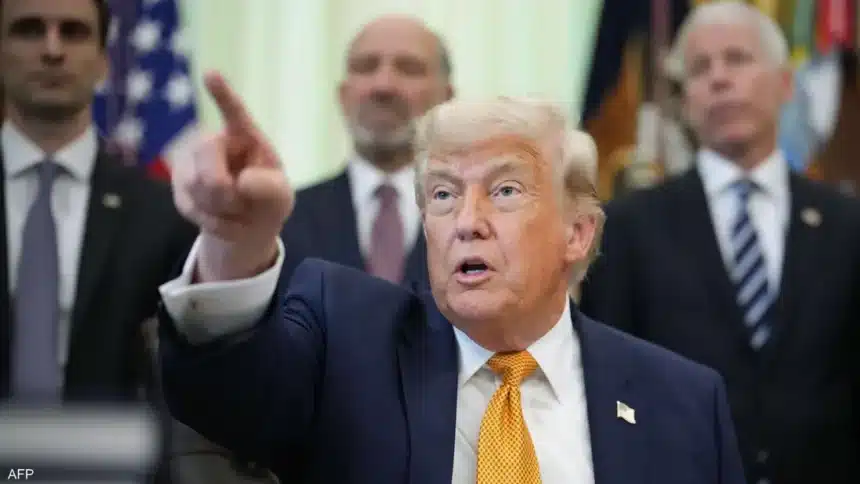
Speaking at the White House, Trump stated that the United States had spent enormous sums over the years to help protect Europe and strengthen its security, yet some key allies failed to respond when Washington sought support during the conflict with Iran.
Trump specifically mentioned the United Kingdom, Germany, and Italy, saying that the United States had asked them to stand alongside it, but they were not there when needed. He did not provide further details regarding the specific type of assistance the U.S. administration had requested.
The remarks come after repeated criticism by American officials who have accused NATO allies of failing to provide sufficient support during the war with Iran.
Questions Over Future Security Commitments
Trump’s comments extended beyond criticism of European positions and included suggestions that Washington may reconsider the level of its future security commitments to Europe.
He noted that the United States spends hundreds of millions of dollars annually to help protect European countries from Russian threats, implying that Washington may become less willing to assist its allies if they continue to withhold support when the United States requests it.
Trump argued that it makes little sense for America to shoulder the burden of defending its partners while those same partners hesitate to provide assistance, even on what he described as “small matters,” referring to issues where Washington expects direct support from its allies.
Rutte’s Upcoming Visit to Washington
The comments came ahead of a visit by NATO Secretary General Mark Rutte to Washington, scheduled to run from Tuesday through Thursday.
The visit includes a meeting with Trump at the White House, as well as a series of discussions with senior U.S. officials on security, defense, and the challenges facing the alliance in the coming period.
The trip carries particular significance amid growing disagreements between Washington and several European governments regarding defense burden-sharing and NATO’s role in international crises.
Trump Hints at Withholding Future Assistance
During another White House press conference, Trump intensified his rhetoric toward NATO members, stating that the United States could refuse to assist certain alliance members if similar situations arise in the future.
He said that America has invested enormous resources in NATO but did not receive the support it expected when assistance was needed in certain matters, adding that Washington could choose to adopt the same approach if it wished.
Despite the current tensions, Trump is expected to participate in the NATO summit scheduled to take place in Ankara next month.
Continued Criticism of European Partners
On Sunday, Trump also criticized Italy’s position regarding the recent conflict between the United States and Iran, arguing that Rome had not treated what he described as the Iranian nuclear threat with sufficient seriousness despite benefiting from NATO’s security umbrella.
Meanwhile, U.S. Defense Secretary Pete Hegseth increased pressure on European allies by announcing last week that the Pentagon would conduct a six-month review of American troop deployments in Europe. He stated that the outcome of the review would be influenced by the willingness of European countries to assume greater responsibility for defense and security.
These statements followed reports that the United States had informed its allies that it might stop providing certain warships and aircraft used in collective defense operations if a NATO member came under attack, prompting several European countries and Canada to explore alternative arrangements to fill potential gaps.
Several NATO members also declined to support the American military campaign against Iran, either by restricting the use of their airspace by U.S. military aircraft or by refusing to deploy naval forces to assist in reopening the Strait of Hormuz.
In recent weeks, Trump has repeatedly described NATO as a “paper tiger” and has more than once suggested the possibility of withdrawing the United States from the 32-member alliance. He argued that many European allies have relied for years on American security guarantees without providing what Washington considers an adequate level of support, particularly during the U.S.-Israeli campaign against Iran.
United News Network – UNN Arabic
An independent media platform that provides reliable news and objective analysis while promoting peace and cultural dialogue around the world, conveying the truth and building bridges of understanding between peoples.
For more news, please visit our homepage:
Author: Advisor Faisal Al-Mutairi
Publication Date: June 23, 2026
Last Updated: June 2026