

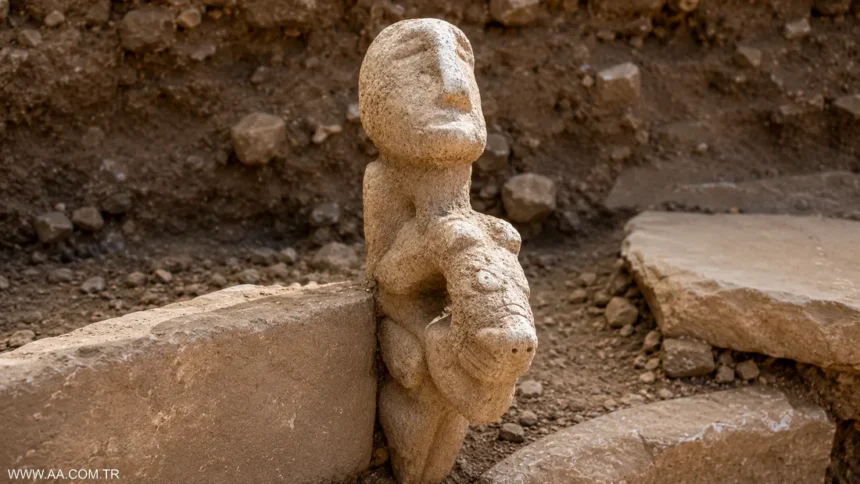
An Exceptional Sculpture Dating Back 11,000 Years
After spending nearly 11,000 years underground, a remarkable stone sculpture depicting a human figure seated on the back of a leopard has come to light, opening a new chapter of questions for archaeologists about the nature of the human communities that lived in one of the world’s earliest known settlement regions.
The discovery was made at the archaeological site of Karahantepe in Şanlıurfa Province in southeastern Türkiye, where the archaeological team found the sculpture during ongoing excavations at the site.
Türkiye’s Ministry of Culture and Tourism announced the discovery on August 25, explaining that the piece dates to the Neolithic period and is estimated to be around 11,000 years old. The ministry noted that the sculpture represents a composite work featuring a style never previously recorded at Karahantepe.
The sculpture stands approximately 70 centimeters tall and depicts a human figure seated on the back of a leopard, bringing a human and a predatory animal together in a single composition. This gives the piece particular significance compared with the human and animal sculptures previously discovered in the region.
Archaeologists found the sculpture on a stone bench attached to the wall of a circular structure measuring approximately 3 meters in diameter, with a floor covered in flat stones.
A Sculpture Found in Its Original Location, Raising New Questions
The significance of the discovery is further enhanced by the circumstances in which the sculpture was found. According to information released by the Turkish authorities, it remained in its original location—the place where the region’s inhabitants left it thousands of years ago. This gives researchers a better opportunity to understand the context in which it was placed and its possible purpose.
Turkish Minister of Culture and Tourism Mehmet Nuri Ersoy said the sculpture’s artistic style had never before been seen at Karahantepe, describing the discovery as an important addition to the understanding of the symbolic and cultural life of the communities that inhabited the region during the Neolithic period.
The scene of a human figure seated on a predatory animal raises a central question about the meaning this imagery may have held for the people who created it around 11,000 years ago.
Researchers do not yet have a definitive interpretation of the sculpture. The scene may have been associated with concepts such as power or control, or it may reflect how these communities perceived the relationship between humans, predators, and the surrounding natural environment. Archaeologists, however, caution against drawing definitive conclusions in the absence of sufficient evidence to establish the purpose for which the piece was created.
Live Science quoted archaeologist Jens Notroff as saying that depicting a human figure in this manner may have been connected to ideas of power or control, while emphasizing that the interpretation remains open to multiple possibilities.
The significance of the new sculpture lies in the fact that it does not depict a human or an animal separately, but instead brings the two together in a single composition. This provides researchers with new material for studying the symbols and ideas that shaped the cultural world of early human communities during this period.
Karahantepe: An Archaeological Site That Continues to Surprise
Systematic excavations at Karahantepe began in 2019, and since then, the site has become one of the most prominent archaeological locations for uncovering new details about the Neolithic period.
Excavations have revealed a range of architectural structures and sculptures depicting humans and animals, in addition to more than 250 T-shaped stone pillars, reflecting a remarkable level of organization and craftsmanship among the communities that lived in the region thousands of years ago.
Karahantepe is part of the Taş Tepeler, or “Stone Hills,” archaeological project, which encompasses a group of archaeological sites in Şanlıurfa, including the renowned site of Göbekli Tepe.
These sites have attracted considerable attention from archaeologists because they date to a pivotal period in human history that witnessed major transformations in settlement patterns and social organization, as well as the development of new ways in which humans expressed their beliefs and perceptions of the world around them.
With the discovery of the new sculpture, another mystery has been added to the secrets of this early period. After 11,000 years, the scene depicting a human and a leopard can once again be seen, but the most important question remains unanswered: Why did Neolithic humans choose to depict a person sitting on one of the most dangerous predators?
United News Network – UNN Arabic
An independent media platform providing reliable news and objective analysis, seeking to promote peace and cultural dialogue around the world, convey the truth, and build bridges of understanding among peoples.
For more news, visit our homepage:
UNN Arabic – United News Network
Author: Consultant Faisal Al-Mutairi
Publication Date: August 30, 2026
Last Updated: August 2026