
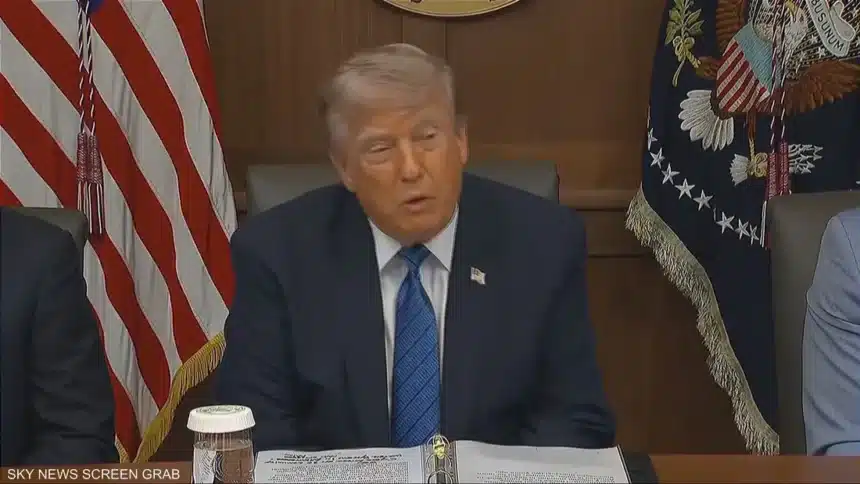
U.S. President Donald Trump said he expects an agreement leading to the reopening of the Strait of Hormuz to be reached soon, describing ongoing negotiations with Iran as making “very good” progress. At the same time, he warned that a large-scale military option remains on the table if the talks collapse or Tehran fails to uphold its commitments, cautioning that any potential confrontation would be “the biggest since World War II.”
During an interview with Fox News while visiting California, Trump stated that the Strait of Hormuz “will reopen very soon,” adding that the alternative would be “a very powerful strike” against Iran as part of U.S. efforts to bring the current crisis to an end.
The U.S. president noted that communication with Iran has continued without interruption, explaining that Iranian officials and mediators held negotiations throughout the day and that the talks are moving in a positive direction, increasing the chances of reaching an agreement in the near future.
Trump also said that Tehran appears eager to put an end to months of tension and conflict, but stressed that it has “one last chance” to reach a deal. He reiterated Washington’s long-standing position that Iran must never obtain a nuclear weapon.
“If they back out again, they’ll be hit very hard… They cannot have a nuclear weapon. It’s that simple,” Trump said, combining encouragement to finalize an agreement with a warning about the consequences of failure.
A Temporary Agreement to Reopen the Strait of Hormuz Under Discussion
Trump’s remarks coincided with a report published by Axios, which stated that the United States, Iran, and Oman are close to reaching a temporary agreement regarding the reopening of the Strait of Hormuz. According to two regional sources and a U.S. official, the U.S. administration was aiming to announce the arrangement on Wednesday.
According to the report, the proposed agreement would establish temporary arrangements between Oman and Iran for a period of 60 days, with the possibility of an extension if all parties agree.
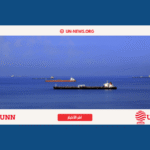
Under the proposed framework, vessels entering the Persian Gulf would follow a northern route through Iranian territorial waters, while ships leaving toward the Arabian Sea would use a southern route through Omani waters, under coordination between Muscat and Tehran.
The proposal also stipulates that no transit fees or taxes would be imposed on vessels during the temporary agreement. In addition, naval mines would be cleared from the central shipping lane of the Strait of Hormuz within 30 days, enhancing maritime security and facilitating commercial navigation.
The Strait of Hormuz is one of the world’s most strategically important maritime chokepoints, carrying a significant portion of global oil and natural gas exports. As a result, any disruption in the waterway has an immediate impact on international energy markets and global trade.
Omani Mediation and Intensive Contacts Between Washington and Tehran
The Axios report indicated that the White House has played a direct role in supporting the negotiations, alongside diplomatic efforts led by the Sultanate of Oman, which continues to serve as a mediator between the United States and Iran.
Over the past few days, a series of telephone conversations reportedly took place between U.S. Special Envoy Steve Witkoff, Iranian Foreign Minister Abbas Araghchi, and Omani Foreign Minister Badr Albusaidi, as part of ongoing efforts to bridge differences and reach a mutually acceptable framework.
According to two regional sources, Araghchi agreed in principle to the proposed arrangements, although final approval required authorization from Iran’s leadership, represented by Supreme Leader Mojtaba Khamenei and the Supreme National Security Council.
A U.S. official and one regional source stated that Iran’s leadership completed the approval process on Tuesday evening, marking an important step toward finalizing the temporary agreement. The parties are now awaiting its official announcement and the implementation of its provisions on the ground.
These diplomatic efforts come as Washington continues to insist that any agreement with Tehran must address Iran’s nuclear program and guarantee the security of international shipping. Iran, meanwhile, views the current understandings as an opportunity to reduce tensions and open a new chapter of negotiations, provided that all parties fulfill their commitments.
United News Network (UNN Arabic)
An independent media platform delivering reliable news and objective analysis while promoting peace and intercultural dialogue around the world, with the mission of conveying the truth and building bridges of understanding between nations.
For more news, please visit our homepage:
Author: Counselor Faisal Al-Mutairi
Publication Date: August 5, 2026
Last Updated: August 2026