
The Israeli Channel 12 reported today (Monday) that the Israeli army is moving toward reducing the scope of its forces’ activity in the “Yellow Line” area inside Lebanese territory, following the signing of a memorandum of understanding between the United States and Iran, which both parties confirmed includes the Lebanese file within its security and political arrangements.
The Yellow Line extends from east to west over several kilometers north of the Lebanese-Israeli border, and intersects at one point with the Litani River. South of this line lie around 55 Lebanese towns and villages that remain under Israeli control. This area is considered one of the most prominent points of field contact in southern Lebanon, making any change in the level of Israeli military activity there an important indicator of shifts in the security landscape related to new regional understandings.
Details of a “tense” call
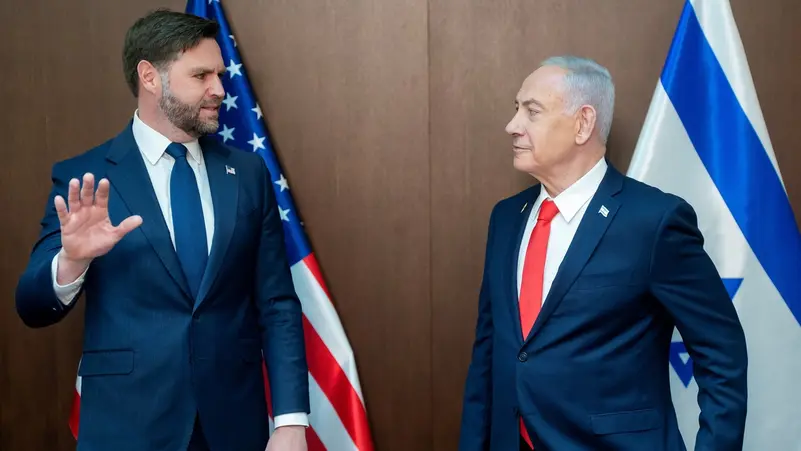
In a related context, Israeli Channel 13 revealed the content of a phone call described as “tense” that took place about 48 hours earlier between Israeli Prime Minister Benjamin Netanyahu and US Vice President JD Vance, which mainly addressed the future of the Israeli military presence in Lebanon, coinciding with the final stages of drafting the US-Iran agreement.
According to the report, Vance briefed Netanyahu during the call on the details of the emerging agreement, while the US side requested discussion of a mechanism for the gradual withdrawal of Israeli forces from Lebanese territory. In contrast, the Israeli government maintained its position insisting on keeping a military presence inside Lebanon’s borders and not carrying out a full withdrawal at the current stage.
The channel stated that both sides eventually reached an understanding on this point, allowing the continuation of the Israeli presence while imposing stricter restrictions and controls on the nature of future military operations. A source familiar with the details of the call said: “It is true that there will be no withdrawal of the Israeli army, but there is no doubt that every military operation will from now on be subject to much greater scrutiny,” indicating increased political and diplomatic oversight of Israeli field movements after the agreement.
Relative calm
This comes at a time when the southern Lebanese front has seen a clear decline in the level of confrontations in recent hours, amid indications of relative calm following the announcement of the US-Iran agreement. However, local Lebanese authorities continued to warn against the premature return of displaced people to their areas amid ongoing fears of renewed tensions or isolated security incidents.
Lebanese and foreign security sources stated that the announcement of the agreement helped reduce escalation levels and establish a state of relative calm in southern Lebanon, although it did not completely stop military operations. Earlier today, Al Arabiya/Al Hadath correspondent reported that an Israeli drone targeted the southern town of Kfar Tibnit, resulting in the death of a car driver in the area.
Despite a noticeable decline in Israeli airstrikes according to security sources, field reports indicated that some Lebanese towns were subjected to intermittent artillery shelling, along with the sighting of a reconnaissance drone flying over Beirut and its southern suburbs, indicating continued Israeli military surveillance of the situation on the ground.
“No freedom of movement for Israeli forces”
In response, a Hezbollah official confirmed that the group has not carried out any military operations since the announcement of the US-Iran agreement, stressing that its position on the ceasefire remains tied to Israel’s compliance with its terms, according to Reuters.
The official, who requested anonymity, added that the group rejects granting Israeli forces freedom of movement inside Lebanese territory, noting that Iran postponed the final signing of the agreement with the United States until Israel’s commitment to the ceasefire on the Lebanese front is confirmed.
However, later field developments included Hezbollah announcing attacks with rockets and drones targeting Israeli forces it said attempted to advance into southern Lebanon, reflecting the continued fragility of the security situation despite the new political track.
This comes amid heavy consequences left by the US-Iran confrontation on Lebanon, where Israeli strikes on the south, the Bekaa, and the southern suburbs of Beirut have killed around 3,800 people and displaced approximately 1.2 million residents. Israeli forces also advanced into dozens of southern towns and villages, while more than 50 areas suffered total destruction, flattening entire neighborhoods and homes into rubble.
United News Network – UNN Arabic
An independent media platform providing reliable news and objective analysis, aiming to promote peace and cultural dialogue around the world, conveying truth and building bridges of understanding between peoples.
For more news, you can visit their homepage:
Author: Advisor Faisal Al-Mutairi.
Publication date: 16 June 2026.
Update date: June 2026