
Ali Al-Taher Heights at the Heart of the Security Tensions
Attention is turning to the “Ali Al-Taher” Heights in the Nabatieh District of southern Lebanon, amid Israeli efforts to impose a new security and geographic reality in the area that, according to informed sources, would grant it not only a «military advantage», but also the ability to provide fire control over areas extending to the Bekaa and the Lebanese coast.
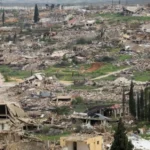
These developments coincide with the continued implementation by Israeli forces of demolition operations that have affected entire residential neighborhoods, as well as the bulldozing of homes and land, alongside airstrikes targeting the “Ali Al-Taher” Heights and their surroundings, increasing the sensitivity of the area, which has become one of the most prominent flashpoints in southern Lebanon.
In contrast, the map of the “experimental zones” does not appear likely to expand in the south during the current phase, amid Israeli rejection of this, while the Italian capital, Rome, prepares to host the eighth round of Lebanese-Israeli negotiations, scheduled to be held on September 1, under U.S. auspices.
In this context, informed sources told “Al Arabiya.net/Al Hadath.net” that Lebanese Army Commander Rodolphe Heikal intends to visit Rome over the next two days, where he is expected to discuss the verification mechanism related to the experimental zones, with the possibility being raised that Italy could be part of this mechanism.
Limited Moves Awaiting the U.S. Position
Diplomatically, reliable sources confirmed that there is «still no U.S. green light» for Israeli forces to launch a large-scale military operation toward the “Ali Al-Taher” Heights.
According to the sources, Israel will continue limited, near-daily military operations, supported by air cover for surveillance and monitoring, with the aim of besieging Hezbollah fighters inside the “Ali Al-Taher” facility and preventing them from leaving it. The sources also reported that Hezbollah had conveyed through mediators its rejection of handing over the facility to the Lebanese Army.
Sources familiar with the group’s position indicate that Israel is considering two options for taking control of the facility: the first is carrying out a large-scale military operation if U.S. approval is obtained, and the second is pushing the Lebanese Army to take control of it in exchange for granting Israel freedom to verify and inspect the site.
However, informed sources explained that the Lebanese Army rejected the idea of taking over the facility and conveyed to the president questions regarding the guarantees that could prevent Israeli forces from returning to it under the pretext of ensuring that it is free of any military activity.
The sources warned that carrying out a large-scale Israeli operation against the Ali Al-Taher facility could reshuffle the cards and change the rules of engagement, noting that Hezbollah would adopt a defensive position if Israel proceeds with a large-scale attack on the area.
Is the Facility a Command Center and Tunnel Network?
For his part, former commander of the “South of the Litani” region, Brigadier General “Khalil Al-Jamil”, ruled out the possibility that Hezbollah fighters are completely besieged inside the “Ali Al-Taher” facility, suggesting that they may retain the ability to move to and from the facility, albeit with difficulty, based on security incidents that occurred recently.
“Al-Jamil” said in statements that the facility may have been a command center for Hezbollah’s southern area, citing its strategic location overlooking Jezzine, Mount Al-Rihan, and Iqlim Al-Tuffah, as well as its proximity to the city of Nabatieh and the northern bank of the Litani River. He also suggested that a facility of this size could accommodate more than 100 personnel to operate and manage it.
“Al-Jamil” noted that information obtained from the large facilities that the Israeli army announced it had discovered indicates that Hezbollah’s advanced operational leadership in the south was distributed across three main sites: the central sector in Bint Jbeil, the eastern sector in Al-Qantara, and the western sector in Majdal Zoun, noting that Israeli forces blew up these sites.
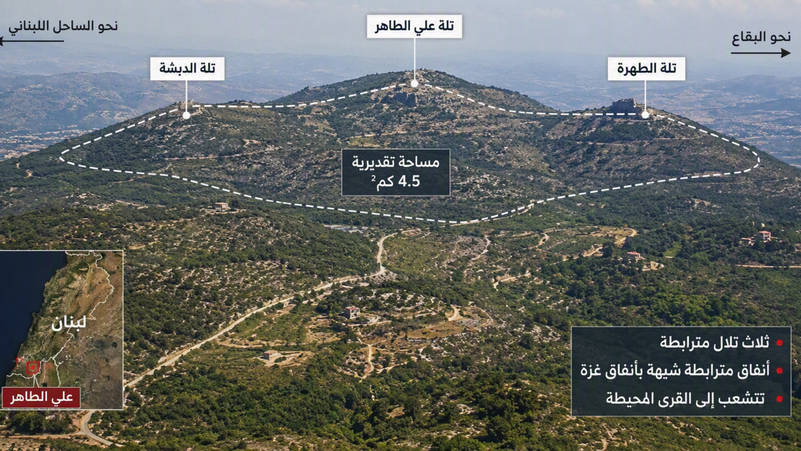
He explained that the “Ali Al-Taher” area consists of three interconnected hills: “Ali Al-Taher”, “Al-Dabsha”, and “Al-Tahra”, covering an area of approximately 4.5 square kilometers, with a length of nearly three kilometers and a width of about one and a half kilometers.
“Al-Jamil” concluded by pointing to estimates indicating that the area contains an interconnected network of tunnels similar to those found in the Gaza Strip, extending through the heights and branching toward surrounding villages, increasing the area’s importance in the military and security calculations of both sides.
United News Network – UNN Arabic
An independent media platform that provides reliable news and objective analysis, and seeks to promote peace and cultural dialogue around the world, to convey the truth and build bridges of understanding among peoples.
For more news, you can visit our homepage:
Author’s Name: Consultant Faisal Al-Mutairi.
Publication Date: August 20, 2026.
Updated: August 2026.