

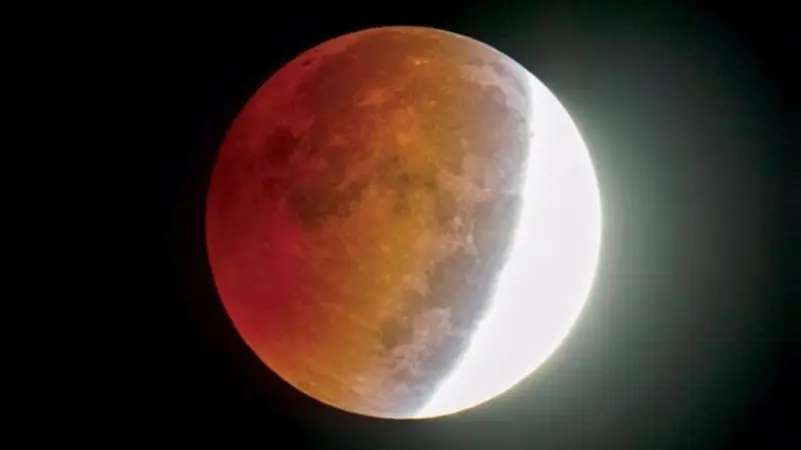
The Eclipse’s Peak Coincides with Sunrise in Cairo
Egypt’s skies will witness a notable astronomical phenomenon in the early hours of next Friday: a partial lunar eclipse coinciding with the full moon of Rabi’ al-Awwal 1448 AH. The phenomenon is expected to be observable during the early morning hours, according to the Egyptian National Research Institute of Astronomy and Geophysics.
The institute explained that Earth’s shadow will cover approximately 93% of the Moon’s surface during the phenomenon, while the partial eclipse phase in Egypt will begin at 5:34 a.m. The eclipse will reach its peak in Cairo at 6:29 a.m., coinciding with sunrise, making this the maximum observable stage from the capital.
The partial eclipse will continue until 8:52 a.m., while all phases of the astronomical phenomenon will last approximately 5 hours and 38 minutes. The actual duration of the partial eclipse will be around 3 hours and 18 minutes.
A lunar eclipse occurs when Earth comes between the Sun and the Moon during the full moon phase, causing Earth’s shadow to block part of the sunlight falling on the Moon’s surface. As a result, part of the Moon appears darkened to varying degrees depending on how deeply it enters Earth’s shadow.
Eclipse Timings in Egypt and Visibility with the Naked Eye
The Egyptian National Research Institute of Astronomy and Geophysics confirmed that observing a lunar eclipse with the naked eye poses no danger to eyesight, meaning those interested can watch the phenomenon without special protective equipment. This differs from a solar eclipse, which requires appropriate eye protection.
The eclipse phases in Egypt will begin at 4:24 a.m., when the Moon enters Earth’s penumbra, although this stage is not clearly visible. The actual partial eclipse will begin at 5:34 a.m., when part of the Moon’s disk starts entering Earth’s shadow.
In Cairo, the Sun will rise at 6:29 a.m., coinciding with the peak of the eclipse, while the partial eclipse will continue until 8:52 a.m. The remaining phases of the phenomenon will then continue until the eclipse ends completely at 10:02 a.m.
Dr. Manar Mohamed Abady, Head of the Solar Research Laboratory at the Egyptian National Research Institute of Astronomy and Geophysics, explained that a lunar eclipse is a natural phenomenon that occurs when the Moon is full and the Sun, Earth, and Moon are positioned approximately in a straight line, with Earth between the Sun and Moon.
She noted that looking at a lunar eclipse does not harm the eyes, allowing it to be observed directly, unlike a solar eclipse, which can damage eyesight if viewed without proper protection.
Astronomical Significance in Determining the Beginning of Hijri Months
The significance of a lunar eclipse extends beyond being a phenomenon that can be observed with the naked eye. Such events have scientific and astronomical value for studying the movement of celestial bodies and determining the beginnings of Hijri months. An eclipse occurs during opposition, when the Moon is full and located near one of the ascending or descending nodes along the ecliptic, causing part of its disk to enter Earth’s shadow and appear darkened.
Lunar eclipses are relatively easy astronomical phenomena to observe compared with some other events. However, the ability to see their different stages varies depending on the observer’s geographical location, viewing conditions, and local timing. As a result, the various phases of an eclipse may appear differently or at different times from one region to another, depending on each location’s position along the phenomenon’s path.
United News Network – UNN Arabic
An independent media platform providing reliable news and objective analysis, seeking to promote peace and cultural dialogue around the world, convey the truth, and build bridges of understanding among peoples.
For more news, visit our homepage:
Author: Counselor Faisal Al-Mutairi
Publication date: August 26, 2026
Updated: August 2026