
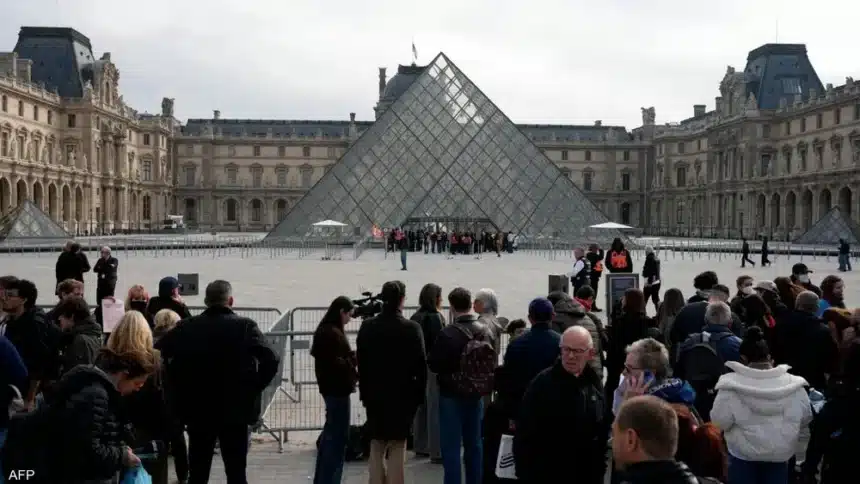
In front of the Louvre Museum in Paris, tourists continued taking pictures despite its doors being closed. While some tried to find out when the museum would reopen and how to obtain ticket refunds, others turned to selfie sticks to document the scene, after the protests became an unexpected part of their trip to the French capital.
Over the past few days, tourists’ routes have intersected with streets filled with protests. Images of damaged shops and clashes have made their way onto visitors’ phones as they documented museums and famous landmarks. Between sticking to their sightseeing plans and changing their schedules for going out, some found themselves facing a reality quite different from the familiar image of Paris.
In a report published yesterday, the French newspaper Le Monde documented tourists who insisted on visiting the capital despite their concerns. They included a Brazilian tourist who decided to travel with her family despite warnings from relatives, while preferring to avoid going out after dark.
Visitors also used their phones to document the aftermath of the unrest and continued taking pictures outside the Louvre, even though it was closed on October 19 following student protests. These scenes reflect contrasting reactions, ranging from caution to determination to complete the trip, without suggesting that the protests have become a tourist attraction.
In a separate photo report, the newspaper documented a woman taking a picture near Place de la République, on a street where tear gas had been used during the night of October 18–19.
Near areas affected by the unrest, some café patrons continued their evenings, while others queued to buy food near a shop that had been looted. Elsewhere, tourists were surprised to find a metro station closed, with riot police present.
Thus, Paris’s streets brought together contrasting scenes: security disturbances, people going about their daily lives, and visitors trying to determine which routes remained available to reach their destinations.
Behind the selfies, however, the protests had practical consequences for tourism. Skift, a website specializing in the travel industry, reported on October 19 that metro stations near the Champs-Élysées had been closed at the police’s request, while several governments had updated their travel advisories for France.
The website quoted G Adventures as saying that its tours had not been affected at the time the report was prepared, despite receiving calls from customers asking about their upcoming bookings. This suggests that the continuation of trips does not eliminate concerns about possible developments.
For tourists, the protests may require changes to transportation arrangements or the postponement of visits to certain landmarks. Tourism companies, meanwhile, face questions about whether their itineraries can proceed as planned and whether visitors will be able to reach their destinations.
For its part, Condé Nast Traveler published guidance on getting around and avoiding areas affected by unrest. In its coverage dated October 20, the magazine explained that restrictions vary between cities and regions, emphasizing the importance of distinguishing peaceful demonstrators from those involved in looting and vandalism.
Ultimately, a tourist may leave Paris with an unusual photograph from the trip. For residents, shop owners, and protesters, however, the same scene remains part of an ongoing crisis that extends far beyond what cameras capture.
United News Network – UNN Arabic
An independent media platform that provides reliable news and objective analysis, and seeks to promote peace and cultural dialogue around the world, convey the truth, and build bridges of understanding among peoples.
For more news, visit our homepage:
Author: Counselor Faisal Al-Mutairi.
Publication Date: October 21, 2026.
Updated: October 2026.