
Satellite images show damage to Iranian naval vessels at Bandar Abbas port
Recent satellite images have revealed the extent of damage sustained by a number of vessels belonging to the Iranian navy following US-Israeli attacks, as visual analysis showed damage to ships at Shahid Bahonar port.
Visual comparisons of satellite images taken between February 26 and May 19 show that a large number of military naval vessels stationed at Shahid Bahonar port in the city of Bandar Abbas in southern Iran were extensively damaged. The images indicate that around four ships were hit with varying degrees of damage as a result of the bombardment that targeted the port.
Satellite image shows damage to Iranian naval vessels at Shahid Bahonar port (FANTOR)
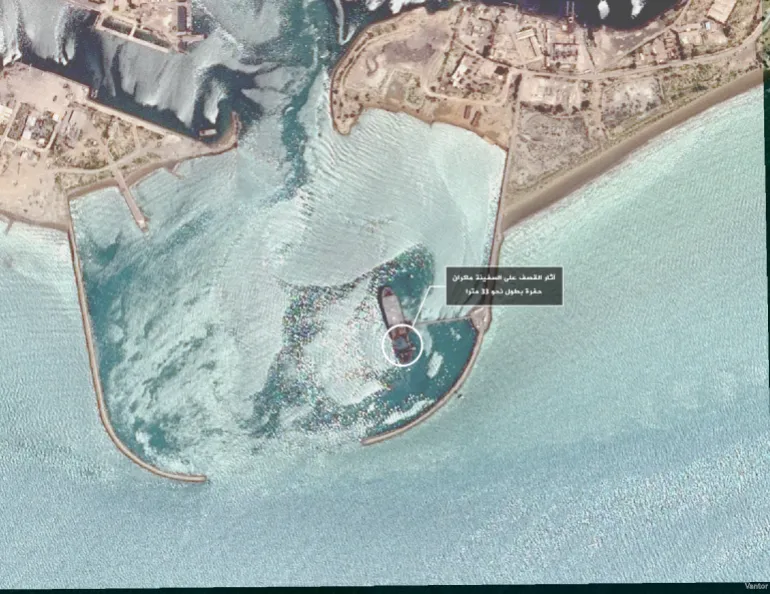
Recent images document direct damage to an Iranian support vessel
In the same context, images captured on May 19 showed a support vessel sustaining a direct strike, with the images revealing a large breach in its deck estimated to be more than 30 meters long, reflecting the scale of major structural damage inflicted on it.
In a related context, U.S. President Donald Trump has repeatedly stated that the U.S. military has “destroyed the Iranian navy.”
The U.S. Central Command also reported that U.S. forces have so far targeted 43 Iranian warships, some of which were destroyed while others sustained severe damage.
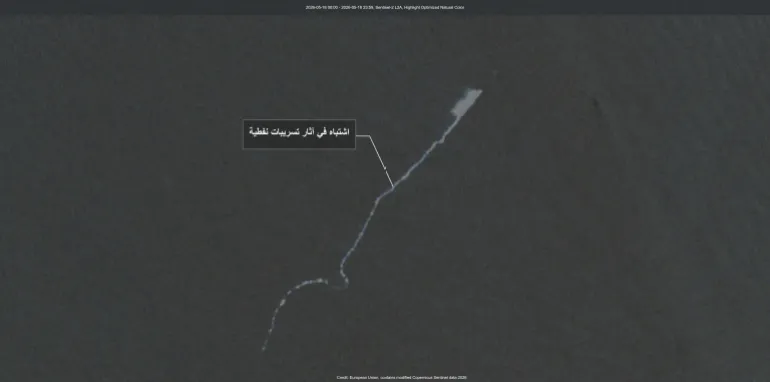
Satellite image suggests suspected oil leak traces (Sentinel-2)
Satellite images reveal damage from strikes on Shahid Bahonar port
At the beginning of March, satellite imagery revealed the extent of damage caused by US-Israeli airstrikes targeting Shahid Bahonar port, one of the oldest and most important Iranian ports in Bandar Abbas in the south of the country.
The images, captured on March 2, 2026, showed a massive fire and thick columns of smoke rising after a vessel and facilities inside the port were struck by air raids.
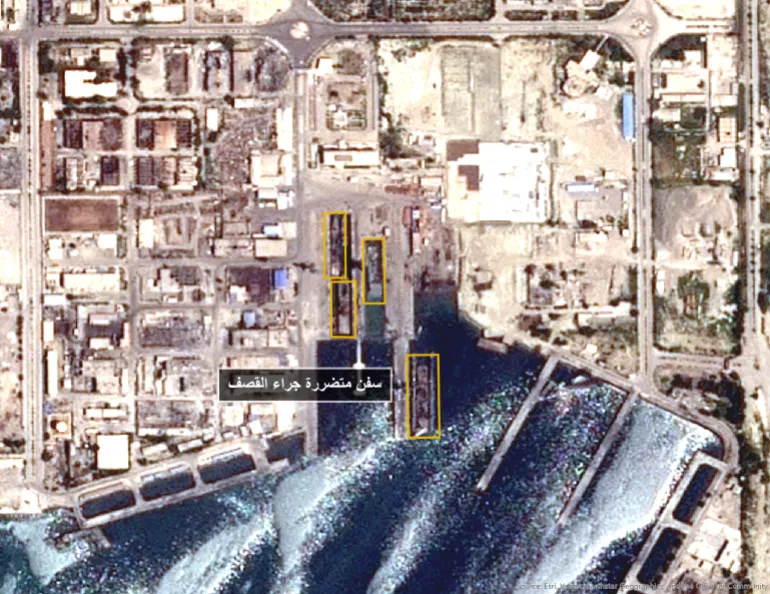
Satellite image shows the extent of damage to Iranian naval vessels due to US strikes (Fantor)
Damage to the ship “Makran” and a strategic site at Shahid Bahonar Port
The satellite footage also showed the extent of damage sustained by the military vessel “Makran” due to the airstrikes. It is a former oil tanker that was converted into a mobile naval base used for logistical support missions and long-range naval deployment, reflecting the nature of the targeting that hit naval assets of operational and strategic importance within the Iranian fleet.
The data shows that “Makran” is considered one of the most prominent naval vessels that Iran relies on to expand the scope of its operations beyond territorial waters, due to its ability to support other ships and provide supplies during long missions, which adds further importance to the scale of the damage it sustained.
In the same context, Shahid Bahonar Port is ranked third among Iran’s transit ports and also holds the position of the second-largest port in Hormozgan Province. It is one of the active ports in exporting non-oil goods, transporting cargo, and passenger movement at both domestic and international levels, making it one of the vital hubs in Iran’s maritime transport system.
Iran’s Revolutionary Guard warns of expansion of war if attacks are repeated
The statement by the Iranian Revolutionary Guard comes in the context of rising regional tensions related to recent strikes that targeted facilities and naval sites in Iran, which were revealed by satellite images showing extensive damage at Shahid Bahonar Port and the military support vessel “Makran,” along with other naval facilities, in a development that reflects the scale of mutual escalation and its impact on the region’s strategic infrastructure.
The Revolutionary Guard confirmed that any similar attack on the country would be met with a strong response, warning that repetition of such operations could lead to an escalation that goes beyond the entire region, potentially opening the door to a more extensive and complex phase of confrontation.
The IRGC spokesperson stated that Iran does not seek military confrontation, but at the same time will take all necessary measures to protect its territory, national security, and vital interests, stressing readiness to deal with any potential threats.
He added that achieving stability in the Middle East serves the interests of all parties without exception, emphasizing the need for self-restraint and avoiding any reckless steps that could expand the scope of military confrontation and increase regional tensions.
Iran map behind Araghchi sparks wide reaction during conference in India
The controversy sparked by the map that appeared behind Iranian Foreign Minister Abbas Araghchi during a press conference in India comes in the context of escalating regional tensions and the exchange of political messages reflected in recent official Iranian statements.
Images of the map have gone viral in recent days, showing Iran in the design alongside verses by the poet Abolqasem Ferdowsi, including the phrase: “If Iran must fall, then let this body fall..”, a quote previously attributed to the late Iranian Supreme Leader Ali Khamenei.
The circulated images showed that the map was displayed inside the Iranian embassy in the Indian capital New Delhi during Araghchi’s participation in the BRICS foreign ministers’ meeting, giving the scene a deep political and symbolic dimension that sparked wide reactions across various platforms.
United News Network – UNN Arabic
An independent media platform providing reliable news and objective analysis, aiming to promote peace and cultural dialogue around the world, conveying truth and building bridges of understanding between peoples.
For more news, you can visit our homepage:
Author: Advisor Faisal Al-Mutairi.
Publication date: 20 May 2026.
Update date: